-
 +679-707-2270
Fiji Islands
+679-707-2270
Fiji Islands
- +1-702-247-4536 US
 +679-707-2270
Fiji Islands
+679-707-2270
Fiji Islands
 Back to Blog
Short version: Fiji dives well all year. The dry season (May to October) gives you the clearest water and the calmest boat rides. The wet season (November to April) gives you warmer water, more marine action, and fewer people in it. Neither is “better,” they’re just different trips.
Fiji earned its nickname, the Soft Coral Capital of the World, honestly, and the range of diving here runs from calm coral gardens to the shark feed at Beqa Lagoon’s Cathedral. But conditions shift through the year, and the right window depends on what you’re after. Here’s how the seasons actually compare.
| Dry season (May–Oct) | Wet season (Nov–Apr) | |
|---|---|---|
| Water temperature | 25–27°C (77–81°F) | 28–29°C (82–84°F) |
| Visibility | 30–40 m, most consistent | Good, more variable near river mouths |
| Sea conditions | Calm, smooth crossings | Warmer, occasional short squalls |
| Crowds | Peak season, busier | Quieter, easier to book |
| Best for | Photography, liveaboards, first-timers, manta and whale windows | Warm water, active marine life, fewer divers |
This is the peak window, and it’s the one to pick if you want clear water, flat seas, and predictable weather. Water temperatures sit around 25 to 27°C (77 to 81°F). Visibility often runs 30 to 40 meters, which is what photographers come for, since the soft coral walls and reef fish show their color best in strong, clean light.
Crossings are smoother in these months, so it’s the easier season for reaching outer reefs and for liveaboard trips that range further afield. It’s also the calmer choice if you’re new to diving or prone to seasickness. Evenings at the resort lean into the dry-season rhythm too: kava at sunset, beachfront fire shows, and dinners on the sand.
A few reasons the dry season stands out:
The wet season brings warmer water, up to about 29°C (84°F), and short tropical showers that usually pass quickly. Those nutrient-rich conditions feed the soft corals and keep the reefs vivid. Marine activity picks up too, with sharks, rays, and big schools of fish moving through, so it’s a good window if big-animal encounters are the draw.
Visibility can vary in this season, especially near river mouths after rain, but the sites around Beqa Island and the offshore reefs generally stay clear. The other upside is space: fewer divers in the water means quieter sites, more guide attention, and easier scheduling. It suits honeymooners and anyone who wants a more relaxed, unhurried trip.
It comes down to your priorities.
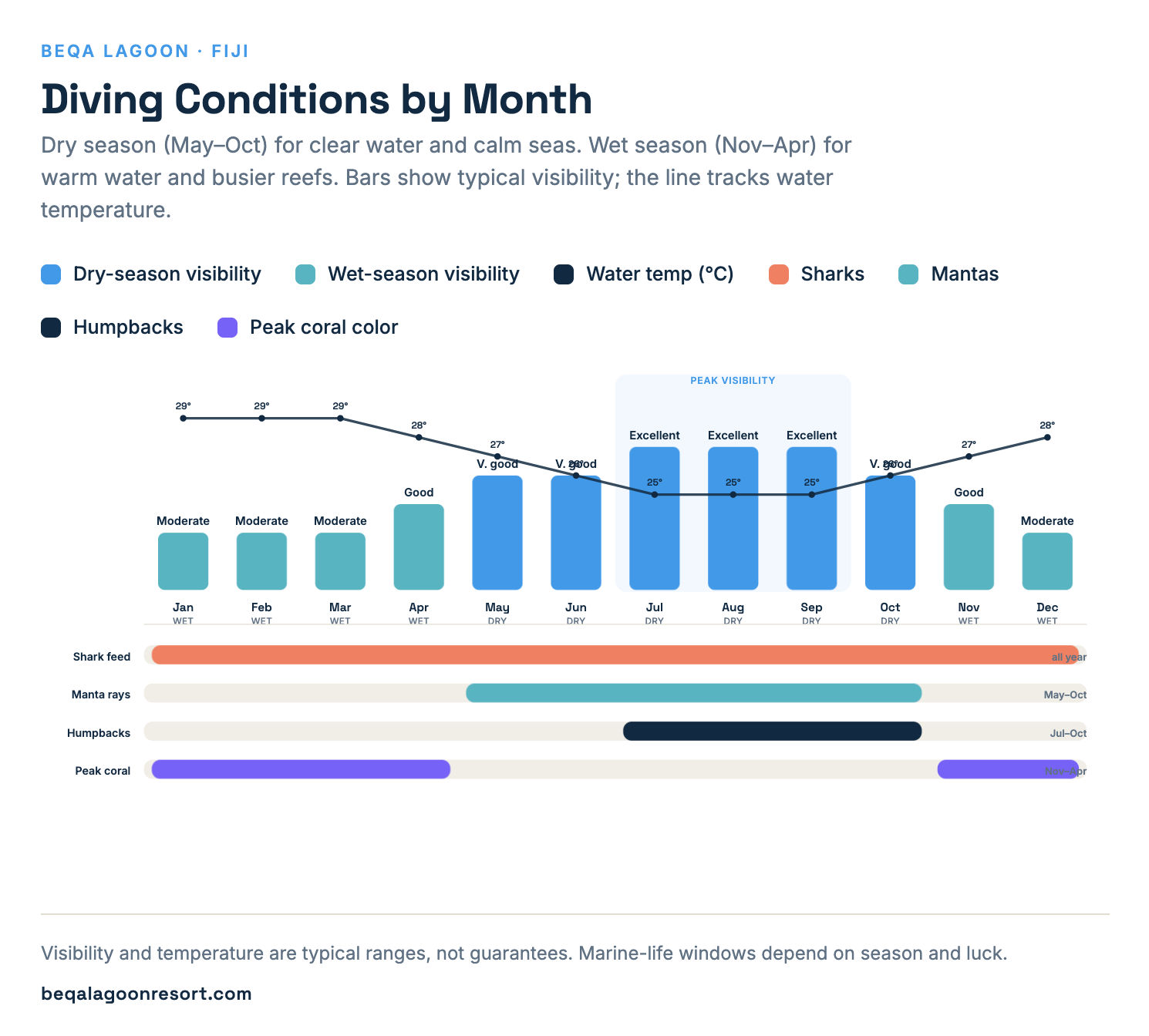
(See the accompanying conditions chart for a visual version of this table.)
| Month | Season | Water temp | Visibility | Notes |
|---|---|---|---|---|
| January | Wet | ~29°C | Moderate | Warmest water, lush islands, quiet sites. Cyclone season, mostly short storms. |
| February | Wet | ~29°C | Moderate | Warm and green, few divers, strong soft coral color. |
| March | Wet | ~29°C | Moderate | Warm water, occasional storms, good macro and critter diving. |
| April | Transition | ~28°C | Good | Water still warm, conditions improving, shoulder-season value. |
| May | Dry begins | ~27°C | Very good | Clear water returns, manta season opens. |
| June | Dry | ~26°C | Very good | Reliable conditions, calm seas, manta sightings. |
| July | Peak dry | ~25°C | Excellent | Best visibility, busiest month, humpback window opens. |
| August | Peak dry | ~25°C | Excellent | Excellent visibility and light, prime for photography, whales around. |
| September | Dry | ~25°C | Excellent | Cooler water, calm currents, great all-round diving. |
| October | Transition | ~26°C | Very good | Calm seas, low rainfall, last of the manta and whale windows. |
| November | Wet begins | ~27°C | Good | Warmer water returns, quieter sites, good value. |
| December | Wet | ~28°C | Moderate | Warm water, festive season, active reefs. |
Best Time to Dive in Fiji
Some encounters are year-round; others have a window. Here’s the honest calendar for the Beqa area and the wider country.
| Encounter | Best window | Notes |
|---|---|---|
| Shark feed (bull, tiger, and more) | All year | The Cathedral feed runs regardless of season. |
| Manta rays | May–October | Reliable at several sites, including Kadavu and the Yasawas. |
| Humpback whales | July–October | Migratory, mostly in the Koro Sea and around Kadavu. A rare treat, not a guarantee. |
| Soft coral at its most vivid | November–April | Warm, nutrient-rich water drives the strongest color. |
The shark feed doesn’t take a season off, so the Cathedral is on the menu whenever you come. What changes is the trip around it. In the dry months you get the glassy mornings, the long-visibility reef dives, and the smoothest crossings. In the wet months you get warmer water, brighter coral, and a quieter resort where dives feel more private.
Either way, non-divers in the group are covered, with snorkeling on the house reef, kayaking, village visits, and cultural evenings. If you’re weighing dates, our rates page shows what’s included, and past guests’ reviews give a feel for both seasons.
Pick the dry season (May to October) if you want the clearest water, the calmest seas, and the best conditions for photography. Pick the wet season (November to April) if you want warmer water, livelier reefs, and fewer people around. Fiji delivers either way, and at Beqa the shark feed is waiting whichever month you land.
Check rates and availability or book your dates now.
Yes. Sharks are around all year, and Beqa’s Cathedral feed runs regardless of season. The dry season (May to October) gives you the clearest water for watching them.
Yes. Rain tends to come in short bursts and rarely disrupts diving. It’s also the quieter season, so you’ll often have sites to yourselves.
July through September. Visibility is at its best, the light is strong, and the soft corals show their fullest color.
Mantas are most reliable from May to October. Humpback whales pass through roughly July to October, mainly in the Koro Sea and around Kadavu. Both depend on the season and a bit of luck.
July and August. If you want quieter sites and easier booking, look at the wet season or the shoulder months of April and November.
Ready to plan your dive trip? See dive packages and rates, explore the Cathedral shark dive, or book now.